Centennial, CO · Garage Door Service
How Centennial's 1960s-70s housing stock and cold-severe winters affect garage door openers and what to check before the next power cut takes yours out.
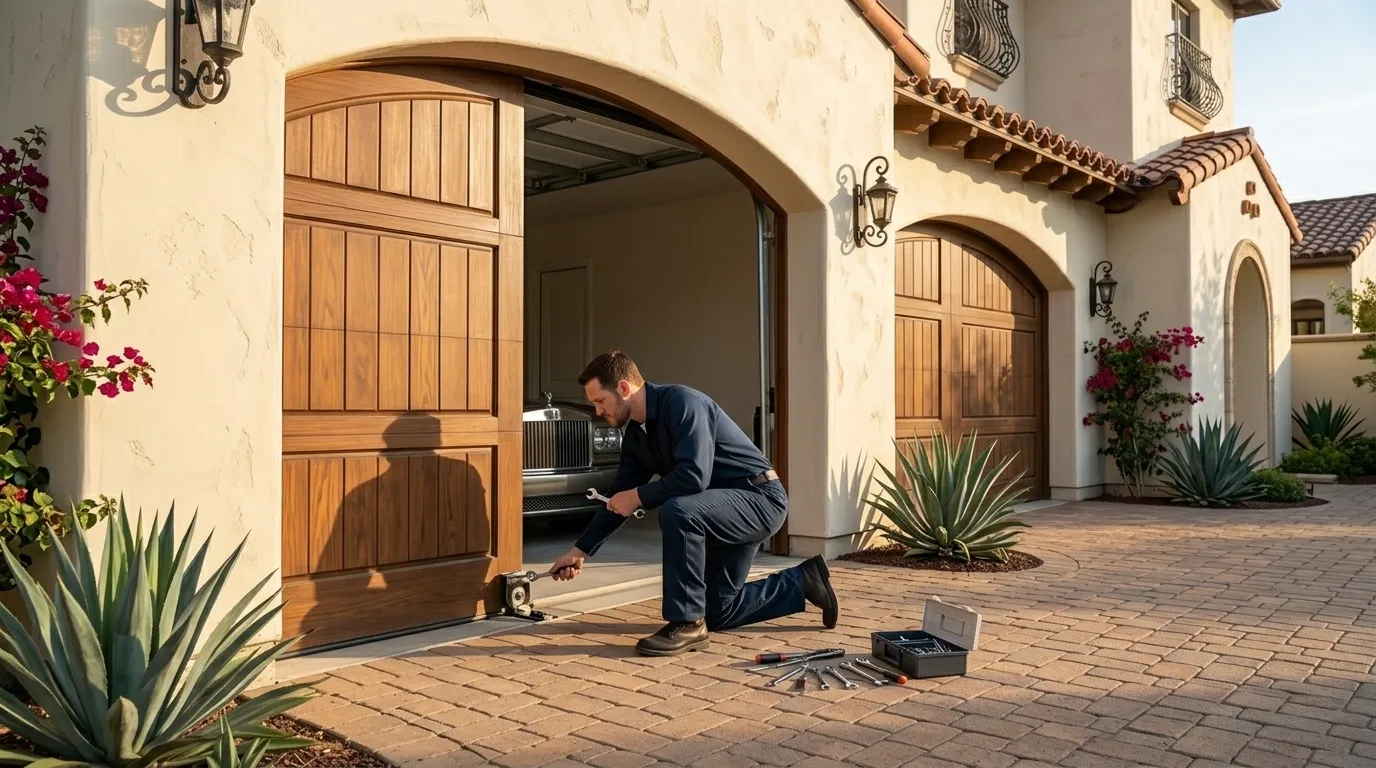
Fall is when this catches people off guard. Most of the houses inside a few miles of Cherry Creek, Meridian, and Foxfield went up in that long stretch between 1938 and 2005, with the bulk of the stock dating to the 1960s and 70s. That means a lot of original openers, or first-generation replacements, wired straight into household power with no battery backup module at all. Those units worked fine for decades because outages were rare and short. They're not built for what a severe cold winter here throws at the grid.
Before the first hard freeze, we'd rather you check your opener's backup status than call us after a storm drops the door mid-cycle. If your opener predates the last ten years or so, there's a real chance it has no battery at all - and no way to tell except by looking at the unit or pulling the manual. That's a five-minute check now versus a stuck car in the driveway later.
We're not going to tell you every opener needs replacing before winter. Plenty of older units are fine mechanically and just need a $30 backup battery pack added. The trick is knowing which one you have.
Start with the obvious: does your opener have a battery backup indicator light, usually a small amber or green LED near the antenna wire? If you don't see one, it probably doesn't have backup power. Next, check the manual release cord - the red handle hanging from the trolley. In a power cut, that's what disconnects the opener from the door so you can lift it by hand. If that cord is missing, tangled in storage boxes, or nobody in the house knows where it is, that's a problem to fix now, not during an outage.
Also worth fifteen minutes: the wall control station. Some Centennial-area homes still run openers with a single-button wall switch and no keypad, which means if the opener loses power and the remote is in a dead car, you're stuck without a workaround. A battery-powered keypad is cheap insurance.
Last, look at the spring type. Torsion springs on doors from the older end of that 1938-2005 build range are more likely to be undersized for today's heavier insulated doors, which puts more strain on the opener motor exactly when cold makes steel less forgiving.
Centennial sits in a cold-severe climate band, and that matters for openers in a specific way: cold steel contracts, lubricant thickens, and a motor that used to lift a door in three seconds starts taking five or six. That extra draw is what trips a breaker or burns out a capacitor on an older unit already running near its limit. It's also exactly the condition under which winter storms knock out power across the service area's roughly 115,397 households - so the outage and the mechanical strain tend to show up together, not separately.
Houses built in the 1960s and 70s, which make up most of the stock across the thirty-odd named areas from Cherry Creek out through Stonegate and beyond, often still have the original garage - uninsulated, unheated, open to whatever the outside air is doing. An opener working inside that kind of garage is fighting harder than one in a newer, insulated build. That's not a flaw in the opener. It's a mismatch between 50-year-old garage conditions and a motor never rated for them.
Here's the honest part: we can sell you a battery backup and a new keypad, but we can't rewire your whole garage's electrical service, and we're not going to pretend a $30 accessory fixes a genuinely undersized circuit. If your opener is tripping breakers regularly, that's an electrical load issue, not an opener issue, and it needs an electrician, not us.
What we can tell you is what we see across the 58,186 owner-occupied houses in this service area: openers installed before battery backup became standard are the ones failing during outages, and they cluster in the older pockets near Cherry Creek and Meridian where the original 1960s-70s garages never got upgraded wiring. If your door won't budge by hand even after you pull the release cord, don't force it - that usually means a spring is loaded wrong, and that's a call, not a DIY fix.
If your opener was installed before battery backups became standard, or you can't find an indicator light on the unit, it's worth checking. Given how often cold-severe winters here bring grid outages, a backup means your door still opens when the power doesn't come back right away.
Cold steel and thickened lubricant make the motor work harder to lift the same door. In houses from the 1960s and 70s with uninsulated garages, that effect is worse because the opener is fighting outside-air temperatures directly, not a buffered space.
Pull the manual release cord - the red handle on the trolley - to disconnect the opener, then lift the door by hand. If you can't find the cord or the door won't move, don't force it; that usually means a spring problem, not just a power problem.
Call now or request a free quote - same-day service on most repairs, upfront written pricing.