Centennial, CO · Garage Door Service
Centennial homes built mostly in the 1960s-70s run original torsion hardware into severe cold. Here's why springs and tracks fail here, and what the fix actually involves.
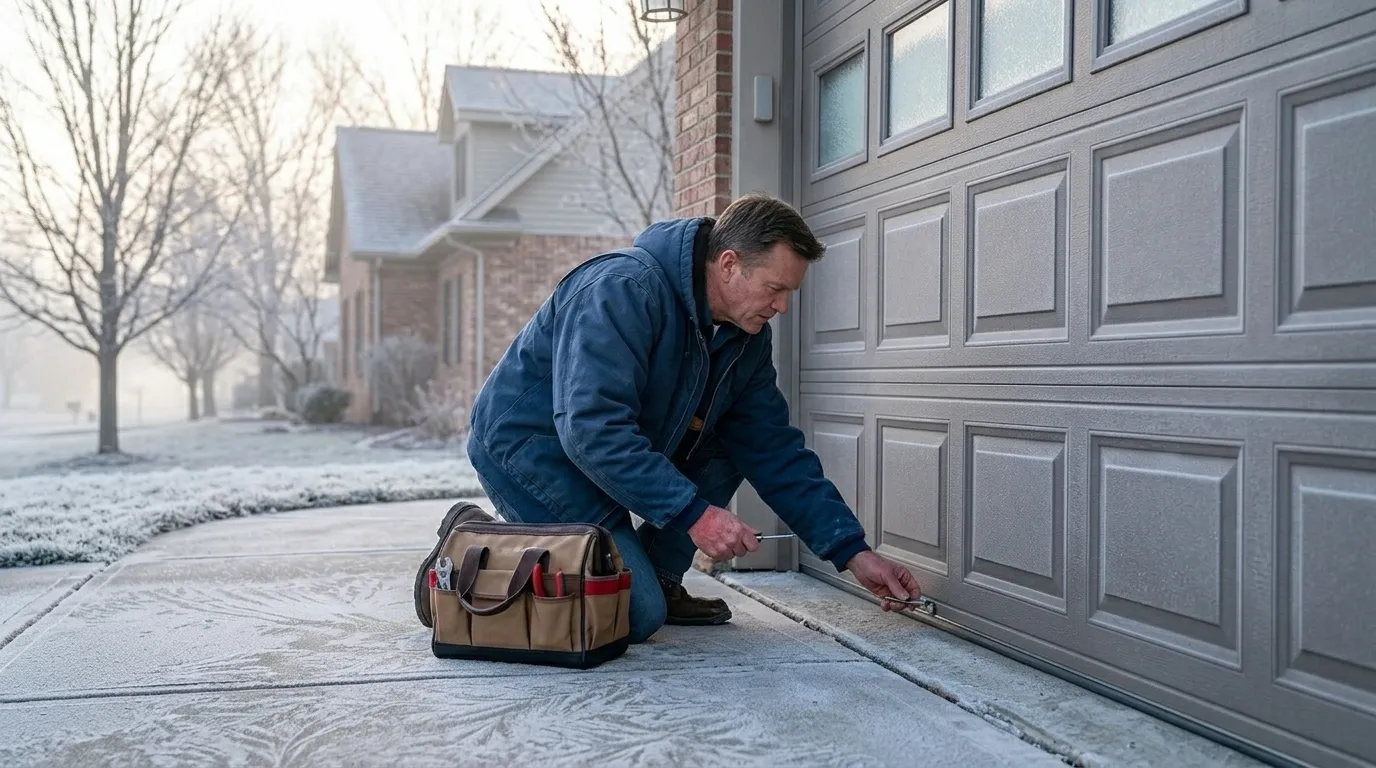
The door won't lift, or it lifts a few inches and stops. Sometimes you hear a loud bang from the garage overnight and the next morning the door is dead weight - the opener strains, the chain skips, or the door drops fast the last two feet. This is a broken torsion spring, and on a double door it's almost always the more dramatic version: the spring snaps under tension and the door goes from working fine to not moving at all in one moment.
On older tracks you'll also see the door walk sideways as it travels, rollers grinding instead of rolling, or the door binding at the same spot every time. That's a sign the horizontal track has racked out of parallel, which on a house with the original hardware is often the spring and the track failing together rather than one causing the other.
Across the 30-plus named areas in this service area, the pattern repeats: a door that worked all summer suddenly won't budge once the temperature drops. That timing is not a coincidence.
Housing in this service area runs from 1938 to 2005, with the median build year at 1978 and most of the stock dating to the 1960s and '70s. That means a large share of the doors still in use are on original or first-replacement torsion springs, sized for the door and header of that era rather than for whatever heavier insulated panel someone bolted on later. Steel fatigues with cycling, and a 45- to 55-year-old spring has done a lot of cycling.
Cold makes it worse. This is a severe cold climate band, and steel contracts and stiffens as temperatures drop. A spring already near the end of its wound life is under more load on a 10-degree morning than it is in July, which is exactly why so many of these failures happen overnight in winter rather than during a warm afternoon. The same cold also thickens old grease on rollers and hinges until they're barely lubricating anything, which is what produces the grinding and the sideways walk on the track.
Put those two together - 1960s-70s hardware plus a hard winter - and you get the failure pattern homeowners here actually see, not a generic breakdown.
A broken torsion spring gets replaced in pairs on most doors even if only one side failed, because the surviving spring is usually within a season or two of the same age and the same fatigue. We match the new spring to the door's actual weight and the drum size on the shaft, not just to what was there before - a lot of these original setups were undersized for later panel replacements, and matching wrong-for-wrong just repeats the failure.
If the track is racked, we pull it back into parallel and check the mounting brackets against the header, since decades of seasonal wood movement in older framing can loosen the lag screws that hold the track in. Rollers get replaced if they're worn oval instead of round - that's a five-minute check but it's the difference between a quiet door and one that grinds again in a year.
One limitation worth saying plainly: if the bottom panel is also cracked or the header wood is soft where the track bolts in, spring and track work won't fix that, and we'll tell you before starting rather than after.
Don't do this one yourself. A wound torsion spring holds enough stored energy to break a bone or worse if it lets go while you're working on it, and that risk doesn't scale down just because the door looks old and tired. Winding bars, a firm grip, and knowing the exact turn count for the spring size are non-negotiable, and none of that is intuitive from a video.
What you can reasonably check yourself: whether the door is binding at the same point every cycle (track issue, safer to inspect), whether the rollers look worn or cracked, and whether the opener's force settings seem to be fighting the door rather than helping it. Any of those are fine to look at before calling. The spring itself is not.
Steel stiffens and carries more load as temperatures drop, and this area sits in a severe cold climate band. A spring that's already near the end of its life from years of cycling is far more likely to fail on a cold morning than during a mild afternoon, which is why most of these calls come in winter.
It's common. Most housing in this service area was built in that window, with the overall stock running 1938 to 2005 and a median build year of 1978. A lot of those garages still have original or early-replacement torsion springs sized for the lighter doors of that period.
Usually both on a double door, even when only one breaks. They're almost always the same age and have done the same number of cycles, so the second one is typically close behind. Replacing just one means a second service call within a season or two.
No. Without the spring, the opener is lifting the full weight of the door by itself, which can strip the gears or pull the bracket out of the header. Leave it closed and call rather than forcing it up.
Call now or request a free quote - same-day service on most repairs, upfront written pricing.